
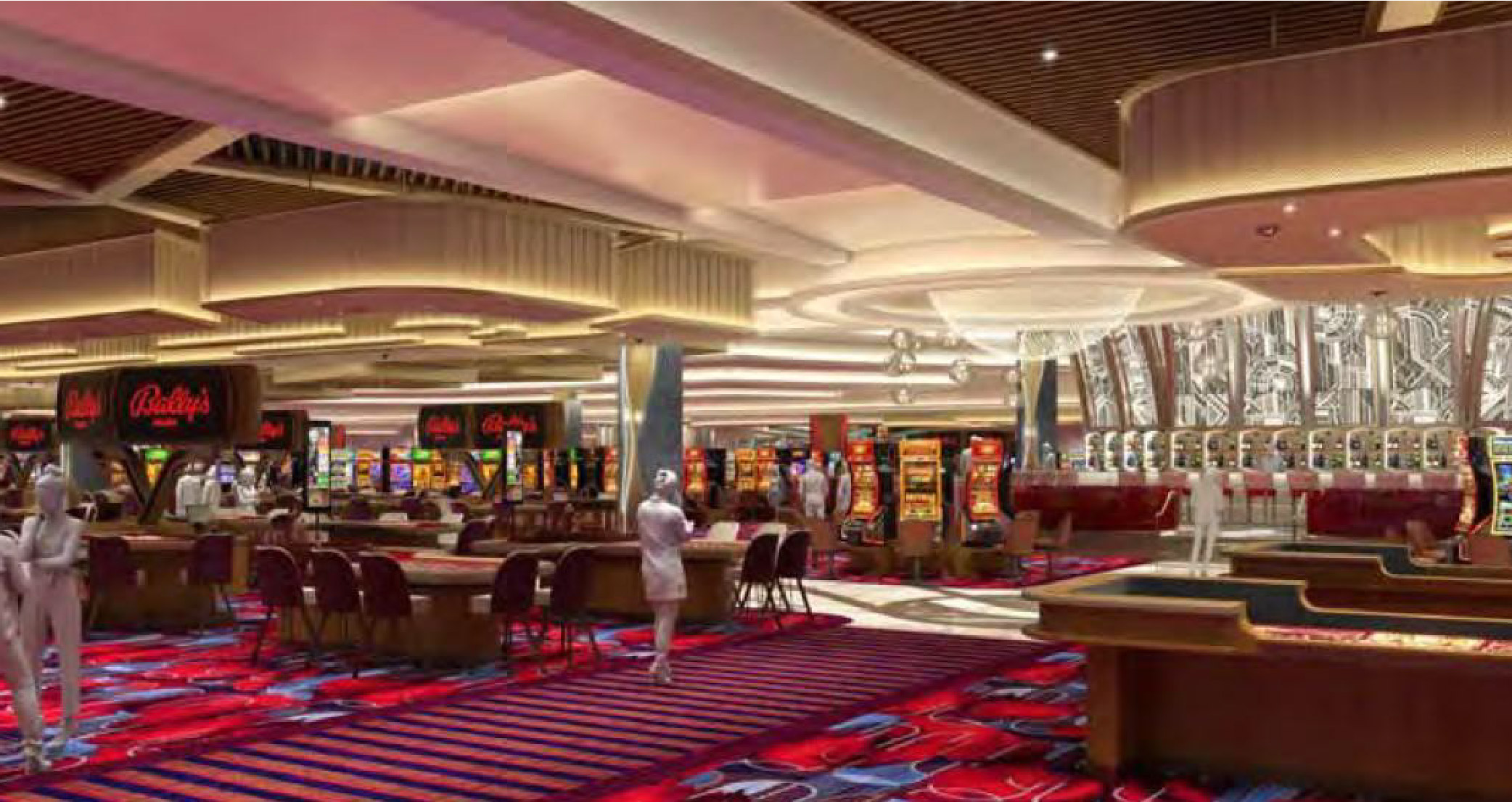
Additional renderings of the interior spaces of the future Bally’s Casino have been released. The project is being built at 777 West Chicago Avenue in the River West neighborhood, near the intersection with North Halsted Street. Based on the current materials, the emphasis is not only on the gaming component, but also on public areas, where visitor circulation will be routed between the riverwalk, the event hall, and the hotel entrances.
Construction on site is moving at an intense pace. In recent weeks, notable progress has been recorded on the hotel portion, including a crane being erected for vertical construction, which typically signals a shift to a faster pace of work on the structural frame.
The project is being developed by Bally’s, and the architecture firm HKS prepared the architectural design. Construction is underway on the site of the former Chicago Tribune Freedom Center, which was fully demolished earlier this year. Over the summer, McHugh Concrete and the Chicago Community Builders Collective worked on the site while staying on schedule set by the city.
There are two timelines being discussed, and they do not fully align. The city’s target is tied to 2026 as the target deadline for completing the permanent casino, while the developer has said it could be ready as early as next year. The launch format remains unclear for now, and public communications do not confirm whether there will be a phased opening.
The project timeline looks fairly straightforward, though with the twists and turns typical of megaprojects. First, the Freedom Center was demolished and the site was cleared for new construction; then in the summer contractors launched an active phase of work, focusing on core infrastructure and the pace of cast-in-place concrete work.
The first interior renderings did not come from a local presentation in Chicago, but amid Bally’s simultaneously advancing a similar initiative in the Bronx in New York City. The current set of renderings overlaps with already visible progress on the River West site, where the hotel portion is gaining its own construction momentum thanks to the crane.
Based on the published parameters, the complex is conceived as a multi-level complex designed for multiple use cases, from a walk along the river to a major show. The key metrics are stated as follows:
What matters in these figures is that the upper levels are largely devoted to parking—that is, to the complex’s engineering and transportation backbone. This approach makes it easier to manage flows, but it makes the quality of the first public floors critically important: that is where it will be decided whether the project is perceived as part of the urban fabric or a self-contained hub.
The space as shown in the renderings is described from the bottom up. At river level, a large plaza is planned in the north corner along with a water taxi stop, and the level itself is positioned as an entry point intended to activate the riverwalk. On this same level, four food-and-beverage outlets are planned, along with entrances to the casino and the event center, linking the promenade route to the building’s primary functions.
The southern portion of the lower level is anchored by a large restaurant at the base of the hotel, with a connection planned to a new public park. This kind of solution typically acts as an anchor that sustains activity not only during event hours, but also during quieter daytime periods, when demand is driven by neighborhood residents and commuter traffic.
One level up is the connection to Jefferson Street, where vehicle access and drop-off areas are planned for the casino and the hotel. In essence, this is a circulation/distribution level that separates arrival scenarios, allowing it to serve gaming peak hours, hotel loading, and event nights at the same time.
The main gaming floor is conceived as a single unified space. It will include 3,400 slot machines and 173 tables, with a large bar planned at the center, and the layout logic is oriented toward clear sightlines and short walking distances between zones—typical for major casinos, where visibility and wayfinding without unnecessary corridors matter.
Dining on the gaming-floor level is pushed to the outer perimeter. Three additional venues and a food hall are planned, positioned to take advantage of windows and river views. Visually, this resembles an approach often used in waterfront mixed-use complexes, where dining becomes a kind of showcase rather than a supporting add-on to the gaming area.
This approach clearly shows how large casino complexes are increasingly assembling the visit experience from multiple layers: gaming, dining, views, event programming, and wayfinding across public levels. In projects like these, what matters is not only the number of tables and slots, but also how convincingly the space holds attention.
At the same time, the broader industry backdrop is changing, as players who prefer online casinos are gradually becoming less likely to see brick-and-mortar casinos solely as a place they need to physically visit. Live dealer games contribute to this most of all, offering a format you can try right from home—hosted shows with studio production and an immersive feel. Because of this, users are increasingly trying the live format instead of making the trip to Bally’s.
Players learn the mechanics of live dealer games, read reviews, and turn to the global web, where they can read more about online casinos for hit titles like Monopoly Big Baller Live, or watch YouTube videos about how Crazy Time works. In response, Bally’s Casino has been building in a broad range of entertainment from the planning stage to interest even the most seasoned players.
To the south will be an event center with a 3,000-seat theater and a small café, and the hotel lobby is also planned here. The visual language of the interiors is described quite specifically:
Above the gaming level, a mezzanine is planned with a poker room and additional meeting spaces. In the hotel tower, three floors of exhibition space for a small museum are designed, and on the 6th floor, in addition to parking, a spa and fitness center are stated. The hotel itself rises to 36 stories and includes 500 rooms; large suites and privileged public areas are planned on the upper levels, including a private members’ club on the 35th floor and a rooftop restaurant with a terrace on the 36th.
Construction continues at an active pace after earlier setbacks that were mentioned previously, and the project budget is stated at $1.7 billion. At the same time, several gaps between target dates and operational decisions remain in the public sphere—items that are usually no less important to residents than the architecture.
It is unclear whether the complex will have a phased opening, and there is no confirmed scenario regarding the future of the temporary casino in River North. These questions remain in a holding pattern as the physical massing of the future building continues to rise on the River West site.